
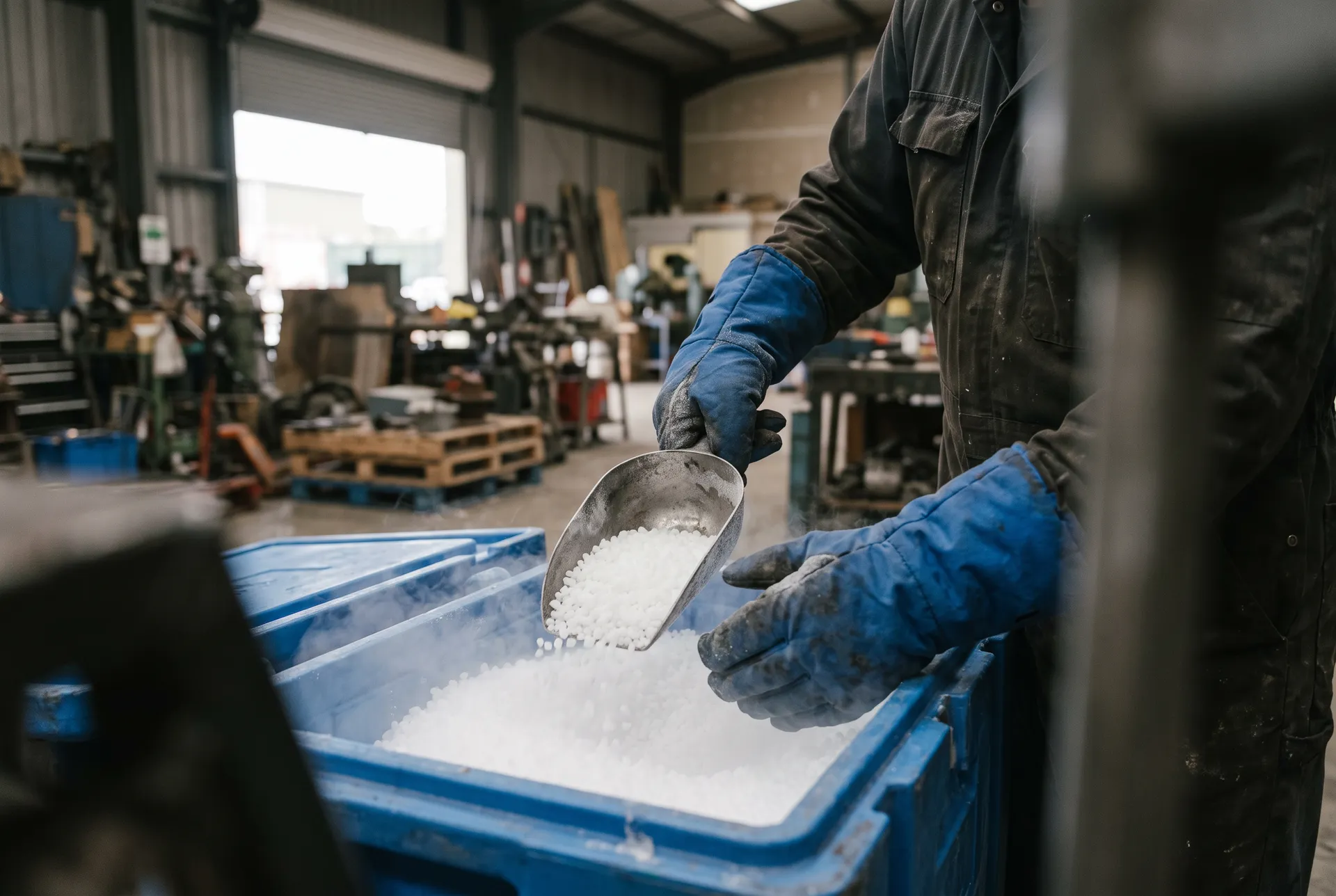
Illustrative visualisation: a worker in insulated gloves scoops dry ice pellets from an insulated box

Safety

Dry ice,
handled with respect.

Dry ice is a safe working material provided you know three of its properties: it is very cold, it turns to gas and it needs space. Here is what that means for transport, storage and work.

Insulated gloves only
−78.5 °C
Ventilate in transit and at work
Gaseous CO₂
Never gas-tight
Open container

Three properties

Where the rules
come from.

  1. Cold

    Dry ice is at −78.5 °C. Contact with bare skin can cause frostbite, so it is handled only in insulated gloves.

  2. Gas

    The ice continuously turns into gaseous CO₂. This is heavier than air, stays near the ground and displaces oxygen in an enclosed space.

  3. Pressure

    A small amount of ice produces a large volume of gas. In a gas-tight container the pressure therefore rises and the container may burst.

In practice

Transport, storage
and work.

A general overview. The safety data sheet of the product supplied and the rules of your workplace are binding.

Transport

  • Carry the ice in an insulated container intended for the purpose, separated from the occupants if the vehicle allows.
  • Ventilate while driving and do not leave the ice in a closed car for longer than necessary.
  • Plan the delivery for the date of the job. The ice diminishes in transit and while waiting.

Storage

  • Store it in an insulated box that is not gas-tight, in a well-ventilated place.
  • Do not put the ice in cellars, pits, small unventilated rooms or walk-in cold rooms.
  • Keep the ice out of the reach of children and unauthorised persons.

Work

  • Use insulated gloves, eye protection and, when blasting, hearing protection as well.
  • Provide ventilation or extraction. In low-lying and enclosed spaces, CO₂ monitoring is appropriate.
  • Do not put the ice in your mouth and do not use it to chill drinks or food unless it is intended for that.

If something happens

First steps
if there is a problem.

  1. Get fresh air

    If you have a headache, feel dizzy or are breathing faster, leave the space and go out into fresh air.

  2. Treat it

    Let the area affected by the cold warm up in lukewarm water. Do not rub it or apply anything hot.

  3. Call for help

    For more serious symptoms or more extensive frostbite, see a doctor. The emergency number in the Czech Republic is 155 or 112.

Frequently asked questions

Questions
about handling.

Can’t find your answer? Write to us and we will add it.

All questions
How long does dry ice last?

It diminishes from the moment it is made, and the rate depends on the container, the quantity and the ambient temperature. That is why we plan the delivery as close as possible to the date of the job and discuss the quantity in advance.

Can I put the ice in a freezer?

An ordinary freezer is much warmer than dry ice, so it will not stop sublimation. Ice does not belong in gas-tight appliances or containers at all.

What should I do with ice left over after the job?

Let it finish sublimating in an open container in a ventilated place that children and animals cannot get to. Do not throw it in the bin, the sink or the drains.

Is this overview binding?

No. It is a general summary. The safety data sheet of the product supplied, the equipment manufacturer’s instructions and the rules of your workplace are binding.

It all fits together

Other directions
that follow on.

Material, equipment, service and partnership.
Choose where you want to go next.

Let’s start with your question

What can dry ice
do for you?

Tell us about your job. Together we will find the next step.

Base
Chebská 53, 356 01 Sokolov
Cleaning
We travel across the Czech Republic and the EU